Tuesday, April 19, 2016

Dilsey Section (3rd person); April Eighth, 1928


The final section of Sound and the Fury consists of a third person omniscient perspective mainly focused on the character Dilsey. I'm sure there is a reason that it is displayed this way. Is it racist? Well, anyone could say that for a lot of books like this. I assume it just gives the view of the events occuring from a perspective that is not of a Compson's. This gives a more rockhard accuracy of the downfall the Compson's are having. All the other chapters bring a different understanding to plot.  

The family name has been tarnished with all these tragedies and disappointments. We already know of Quentin's death, Benjy's idiocracy, and even Miss Quentin now.  She is very rebellious like her mother we come to see. Caddy is now in the North and has abandoned the South because she knows she cannot grow that much there anymore. There is more opportunity in the North.

Religion seems to be a big part of Dilsey and why she comtinues to move on with the Compson family. She even cries on the sermon of Jesus' sacrifice which seems to relate how she also loves Benjy so much. Through this last section, we see that she makes sure Benjy is taken care of by constantly telling Luster to feed him and take him out. When Benjy is rerouted in the carriage, he does not like the path of change. Now the story is back in Benjy's perspective. This symbolises the South's inability to tread down a new path. Why does it matter? Well it actually doesn't. This story is is just a story "told by an idiot". Therefore it means nothing. This story will just be laid in the dust of the same old path.

Friday, April 15, 2016

Jason's Section; April 6th, 1928:


In this section, Faulkner attempts to make us want to hate Jason's character and we absolutely should. Right off the bat he has an offensive remark on Miss Quentin. He seems to mistreat her greatly through excessive discipline. He even eventually gives Quentin ten out of the fifty dollars that Caddy had sent by tricking her into signing off. He is very cunning and smart in getting what he wants. He seems to have an absence of sypathy or selflessness towards others. Even when he was a child he use to snitch on his brothers and sisters. There is even that one time where he cut up Benjy's paper dolls with no reason to. Unlike Quentin, Jason does not put up with Benjy or the others since he is the only "sane" one in the family.

Jason had always been the favorite child in the Compson family. Especially from his mother since she thought him and Uncle Maury were the only last good Compsons after Mr. Compson passed away. Quentin was also one  since he was a really big hope for the family who had gone to Harvard but as we know did not follow through. That education could have been his which may explain is rudeness. Now he must be the breadwinner for the Compsons since Caddy is gone and he is the last Compson child in the house besides Benjy.

This family is now an embarassement to the whole town. Since Caddy got married and was pregnant and then left. Quentin had committed suicide. Benjy sacrifices his innocence for the rest. I think this has caused him to think he is superior over the rest and makes him greedy and mischievous.

There may be reason as to why Jason mistreets his niece so much. It may be due to Caddy who was the "fallen" women and that has passed on to the daughter. He tells her that she is an embarrasment like her mother. He attempts to discipline her and threaten her because he thinks she will be very rebellious and sneaky like Caddy. We eventually see that that is exactly the case when she was suppose to go to school but instead sneaks away to the man with the red tie and suit. Jason just wants to keep the pride and respect in the family. Even though he tries he fails to do it himself. I think that he has reason to act the way he does to some extent. He needs to be the replacement to the wise Mr. Compson.


Monday, April 11, 2016

Quentin's Section; June 2nd, 1910


Quentin's chapter was different from Benjy's. He was though very obsessed with time whereas Benjy just spoke through different memories and time periods.

Quentin also still thinks about the past and his sister which is kind of odd. After all it is the south. On a serious note he does obsess about time and it frustrates him. He thinks about Caddy and her virginity and how he wanted to conserve her innocence. One way he attempted to do this was by telling his father that he committed incest with Caddy. He even remembered the time he wanted to fight Caddy's future husband. 

All these memories that Quentin thinks about haunt him. This is the reason he despises time and obsesses over it. He hears it tick continually in his room while he thinks and is interrupted by Shreve, his roommate. He wants time to stand still and represents this by breaking his watch on his dresser. Even though he tries to break it though, it continues to tick. 

Quentin spoke about Christ crucifixion in his chapter and it reminded me of Benjy and his sacrifice. Quentin remembers how his father told him that "Christ was not crucified: he was worn away by a minute clicking of little wheels. That had no sister".  This is interesting since Benjy did have a sister and the date of his birthday is the day before resurrection. 


Monday, April 4, 2016

Benjy's Chapter; April 7th, 1928:

The first chapter of William Faulkner's The Sound and the Fury is narrated by one of the Compson children Benjy, who was known before as Maury.  The most noticeable aspect of Benjy's narration is that he is infatuated with Caddy who is very soft-spoken and seems like the only one who can comfort Benjy. Throughout the reading, we can see that various events cause him to remember various periods in the past. Benjy also seems to cry and moan when reminded of Caddy. The first example of this is when they are playing golf and they call for the "caddie". When he gets caught by the fence he recalls a period in his youth with Caddy.

An interesting concept that I had discovered during this section of the novel is that Benjy oddly likes certain smells such as Versh's house and the smell of T.P on the bed. The most prominent one is when he actually gets comforted by Caddy's scent and repeatedly notes her "tree smell". Their relationship is really interesting. She is really caring for Benjy and in a way he looks after her as well. We see this in a few flashbacks. One being when Caddy loses her virginity and she cannot go to Benjy due to guilt. Another was her wedding day.

Benjy is not treated very well in the family or any of the three caretakers in the memories and the present. One of the caretakers, T.P, even gets Benjy drunk and is entertained by it. Luster continually is annoyed by Benjy's "slobbering and moaning". His mother even changes his name to Benjy in one memory. Even though they think that he is still a baby in his body, he still knows and recognizes his surroundings and how they affect him.


Tuesday, March 22, 2016

Research on Faulkner:

William Faulkner was born on September 25, 1897 in New Albany, Mississippi. He was named after his grandfather William Clark Faulkner who was involved in many professions but was shot in Riley, Mississippi. The railroad business in the family had kept the family financially stable but the environment in the home was not the best.

William's father, Murray, was an alcoholic which affected his hardheaded mother. This caused constant bickering in the home which you could imagine could have taken a toll on William. Murray eventually though had to look for a different job since the railroad business shut down later. This all led up to Billy needing someone to look after him. An African American lady named "Mammy" Callie did just that. She devoted herself to him and he recieved proper love.

Faulkner in high school had met an aspiring poet named Phil Stone who taught Billy the basics of rhythm and verse in poetry. He was also uninterested in learning at school since he already knew it or he didn't care to. He decided to drop out in the 11th grade and work at a bank for his grandfather. Then Billy became an alcoholic while writing poetry. This would stick with him his whole life. So far, Billy's story does not seem so promising. 

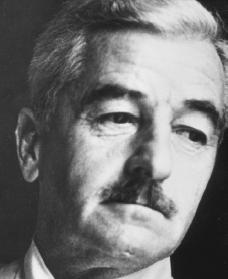
William Faulkner. Reproduced by permission of Archive Photos, Inc. The man to the left of this text actually came out to be really successful. We can talk about that later. First we will talk about his eagerness to join the Great War. He was rejected in 1918 for only being 5 feet and 5 inches tall. He then moved on to join the Canadian Air Force he had gotten an injury early in his piloting career and was sent home.

Now we may move on to the greatness that Faulkner presented to the country. After his attempt at being a good pilot, he went to the University of Mississippi (Ole Miss) just as Phil Stone had. He then had various jobs that he got fired for reading such as being a postmaster. He also became a script writer in Hollywood and wrote some novels. 


Image Below: Faulkner hitting the pipe at his desk at Warner Bros. Studios.

Billy's work had finally been recognized after the second world war. He had the help of Malcolm Cowley who wrote about him and word spread. Faulkner was even recognized for the 1949 Nobel Prize in Literature. He later married as well and died in 1962 at the age of sixty-four.

Notable Works:
  • Sound and the Fury
  • Short Novels such as : these Thirteen, Doctor Martino, Other Stories, and more
  • Poems: The Marble Faun, The Green Bough 


References: biography.com, notablebiographies.com,  famousauthors.org